
Titrations
Core Concept
Titrations are analytical procedures used to determine the unknown concentration of a solution by reacting it with a solution of known concentration, called the titrant. By measuring the exact volume of titrant needed to reach a stoichiometric balance, you can calculate the molarity of the sample.
Key Principle: The reaction between the titrant and analyte (unknown solution) must be stoichiometrically balanced.
Key Tips
The Equivalence Point: This is the exact moment in a titration when the moles of titrant added are chemically equivalent to the moles of the substance being analyzed.
The End Point: Often confused with the equivalence point, this is the physical moment when an indicator changes color, signaling that the titration is complete.
Standard Solution: The titrant is a "standard" solution, meaning its concentration is precisely known and verified before the experiment begins.
The Buret’s Role: This specialized glassware allows for the drop-by-drop addition of liquid, providing the high precision necessary to identify the exact volume used.
Test Yourself
Podcast Episode
Practice Problems & Worked Out Examples 🔒
Browse by category
Titration Stoichiometry and Concentration Calculations
→ 02Interpreting Titration Curves (Strong vs. Weak)
→ 03Strong Acid-Strong Base (SA/SB) Titrations
→ 04Weak Acid-Strong Base (WA/SB) Titrations
→ 05Weak Base-Strong Acid (WB/SA) Titrations
→ 06Comparative Analysis of Vertical Regions (Inflection Points)
→ 07Speciation and Distribution throughout the Titration
→ 08Other / Uncategorized
→ 09Assorted Multiple Choice
→Types of Titrations
Acid-Base Titrations
Process: Involve the neutralization reaction between an acid and a base.
Example: Determining the concentration of $HCl$ using $NaOH$ as the titrant.
Redox Titrations
Process: Based on oxidation-reduction reactions where electrons are transferred between the analyte and the titrant.
Example: Determining the concentration of $Fe^{2+}$ using $KMnO_4$ (Potassium Permanganate).
Complexometric Titrations
Process: Involve the formation of a stable complex ion.
Example: Determining metal ions (like $Ca^{2+}$ or $Mg^{2+}$) using EDTA as the complexing agent.
Precipitation Titrations
Process: Based on a reaction that forms an insoluble precipitate.
Example: Determining $Cl^-$ concentration using $AgNO_3$ (Argentometric titration), which forms a white $AgCl$ precipitate.
Key Terms
Equivalence Point: The point at which the moles of acid equal the moles of base. For strong acid-strong base titrations, this occurs at $pH = 7$.
End Point: The point where the indicator changes color, ideally very close to the equivalence point.
Indicators: Substances chosen to change color at the specific pH of the equivalence point.
Phenolphthalein: Colorless in acid, pink in base ($pH$ range 8.2–10).
Methyl Orange: Red in acid, yellow in base ($pH$ range 3.1–4.4).
Acid-Base Titration Calculations
Select the specific type of acid-base titration from the titration generator menu. Once selected, the corresponding pH calculator will automatically configure itself to provide precise calculations tailored to that specific chemical reaction.
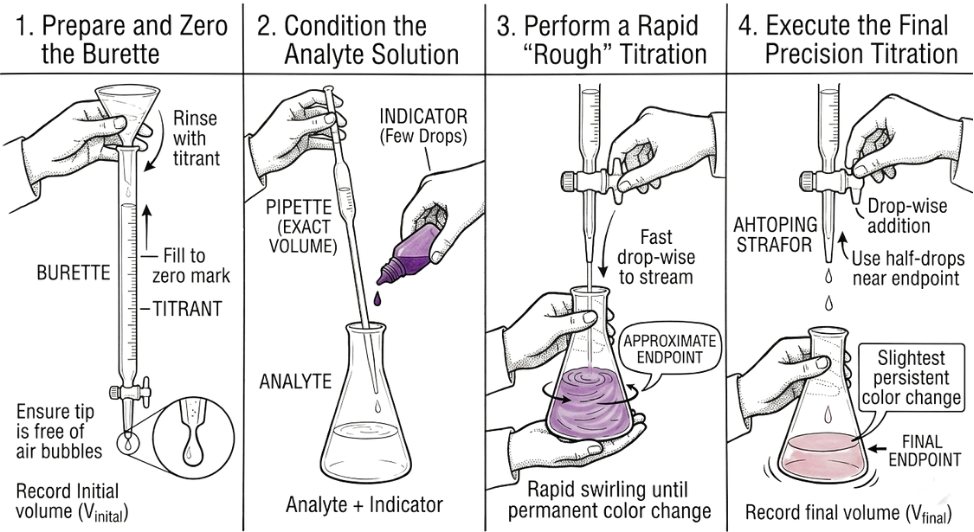
Steps in Acid-Base Titration
The procedure is carried out in four key stages. These involve setup and calibration of the burette, preparation of the sample with an appropriate indicator, and a two-phase titration process designed to first locate and then precisely pinpoint the exact endpoint.
Topic Related Resources
Lab
Coming Soon...
Lab
Coming Soon...
Demo
Coming Soon...
Demo
Coming Soon...
Activity
Coming soon...
Activity
Coming soon...
Simulation
Strong Acid with Strong Base Titration Generator and pH Calculator
Simulation
Strong Base with Strong Acid Titration Generator and pH Calculator
Simulation
Weak Acid with Strong Base Titration Generator and pH Calculator
Simulation
Weak Base with Strong Acid Titration Generator and pH Calculator