
Heating & Cooling Curves
Core Concept
Heating and cooling curves show how the temperature of a substance changes as it absorbs or releases heat. These curves illustrate phase changes and the energy required to change a substance’s state (solid, liquid, or gas).
Key Tips
The flat portions represent phase changes (melting, boiling, freezing) where temperature remains constant.
The sloped portions represent heating or cooling within a single phase (solid, liquid, gas) as temperature changes.
The heat for phase changes is calculated using $q = m \Delta H$ (e.g., $\Delta H_\text{fus}$ for melting, $\Delta H_\text{vap}$ for boiling).
The heat for temperature changes is calculated using q=mcΔT, where c is the specific heat capacity of the phase.
During phase changes, all the energy goes into breaking or forming intermolecular forces, not changing temperature.
Different phases have different specific heat capacities, influencing the slope of the line during heating or cooling.
Test Yourself
Podcast Episode
Related Examples and Practice Problems
Browse by category
Qualitative Interpretation of Curve Segments
→ 02Energy Calculations for a Single Phase or Transition
→ 03Multi-Step Energy Synthesis (Crossing One Phase Change)
→ 04Comprehensive Full-Curve Calculations
→ 01Analysis of Slopes and Heat Capacities
→ 05Other / Uncategorized
→ 06Assorted Multiple Choice
→Key Components of Heating and Cooling Curves
Temperature Plateau (Flat Sections):
The flat portions of the curve represent phase changes where temperature remains constant.
Heat of Fusion ($\Delta H_{\text{fus}}$): The energy required for a solid to melt into a liquid (or for a liquid to freeze into a solid).
Heat of Vaporization ($\Delta H_{\text{vap}}$): The energy required for a liquid to vaporize into a gas (or for a gas to condense into a liquid).
🧠 Remember the 3 Ps: Plateau, Phase change and Potential Energy Change.
Sloped Sections:
The sloped portions represent temperature changes within a single phase (solid, liquid, or gas).
During these segments, the substance’s temperature changes as it absorbs or loses heat, but it doesn’t change phase.
Phase Changes:
Melting: Transition from solid to liquid.
Freezing: Transition from liquid to solid.
Vaporization: Transition from liquid to gas.
Condensation: Transition from gas to liquid.
Specific Heat (c):
The amount of heat needed to raise the temperature of 1 gram of a substance by 1°C (for each phase).
Different phases of a substance have different specific heat values.
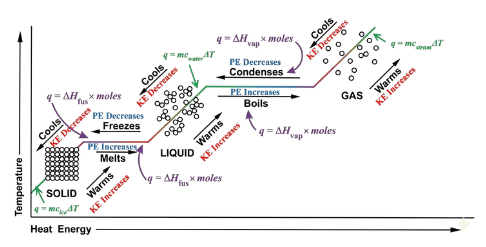
Interpreting a Heating Curve
A typical heating curve for water (as an example) consists of the following steps:
Solid Phase (Heating Ice):
Temperature increases as heat is added, but the substance remains in the solid phase.
Heat Calculation: $q = m \cdot c_{\text{solid}} \cdot \Delta T$
Melting (Ice to Liquid Water):
Temperature remains constant as ice melts to liquid water. The added energy goes into breaking intermolecular forces rather than raising temperature.
Heat Calculation: $q = m \cdot \Delta H_{\text{fus}}$
Liquid Phase (Heating Water):
Temperature increases as liquid water absorbs heat.
Heat Calculation: $q = m \cdot c_{\text{liquid}} \cdot \Delta T$
Vaporization (Liquid to Gas):
Temperature remains constant as liquid water vaporizes to steam. The heat added overcomes intermolecular forces to separate molecules into the gas phase.
Heat Calculation: $q = m \cdot \Delta H_{\text{vap}}$
Gas Phase (Heating Steam):
Temperature increases as steam absorbs heat.
Heat Calculation: $q = m \cdot c_{\text{gas}} \cdot \Delta T$
Tips for Solving Heating and Cooling Curve Problems
Separate Each Phase: Calculate the heat required for each phase change and temperature change separately.
Use Correct Specific Heat and Heat of Phase Change: Ensure that you use the specific heat or enthalpy value appropriate for each phase (solid, liquid, or gas).
Double-Check Units: Convert all masses to grams, temperatures to Celsius or Kelvin as needed, and energy to joules or calories.
Add Heat Values: For total energy calculations, sum all heat values for each phase change and temperature segment.
Topic Related Resources
Lab
Coming Soon...
Lab
Coming Soon...
Demo
Coming Soon...
Demo
Coming Soon...
Activity
Coming soon...
Activity
Coming soon...
Simulation
ChemLEAP Phase Transitions
Simulation
Coming soon...