
Intermolecular Forces
Core Concept
Intermolecular forces (IMFs) are forces of attraction or repulsion between molecules. These forces are weaker than intramolecular forces (bonds within a molecule), but they significantly impact the physical properties of substances such as boiling points, melting points, and solubility.
Purpose: IMFs determine the state of matter (solid, liquid, gas) and influence how molecules interact with each other in different phases.
Practice Tips
Identify Polarity First: Determine if a molecule is polar or nonpolar before choosing a force; if it is nonpolar, it only has London Dispersion Forces.
Check the H-Bond Criteria: Look specifically for H-N, H-O, or H-F bonds; simply having Hydrogen and Oxygen in the same molecule is not enough to form a Hydrogen bond.
Compare Molar Mass: When comparing two nonpolar molecules, the one with the higher molar mass (more electrons) will have stronger London Dispersion Forces. If both have same molar mass, consider surface area.
Rank by Strength: Always remember the general strength hierarchy—London Dispersion < Dipole-Dipole < Hydrogen Bonding < Ion-Dipole—to predict physical properties accurately.
Test Yourself
Podcast Episode
Practice Problems & Worked Out Examples 🔒
Browse by category
Identifying All Intermolecular Forces Present in a Pure Substance
→ 02Distinguishing Between Intermolecular and Intramolecular Forces
→ 03Analyzing the Effect of Molecular Structure on London Dispersion Forces (LDFs)
→ 04Identifying Hydrogen Bonding Capability and Explaining its Unique Strength
→ 06Other / Uncategorized
→ 07Assorted Multiple Choice
→There are three (3) primary types of Intermolecular Forces:

London Dispersion Forces (LDF)
Definition: London Dispersion Forces are the weakest intermolecular force, caused by temporary dipoles that occur when electrons in atoms or molecules shift positions momentarily.
Key Features:
Present in all molecules, whether polar or nonpolar.
Strength increases with the size and mass of the molecule.
Example: The interaction between noble gas atoms like helium (He) and neon (Ne) or between nonpolar molecules like oxygen (O₂) and nitrogen (N₂).
Factors Affecting LDF:
Molecular Size: Larger molecules with more electrons have stronger London dispersion forces.
Molecular Shape: Molecules with more surface area in contact with each other (linear vs. spherical shapes) experience stronger dispersion forces.
Dipole-Dipole Interactions
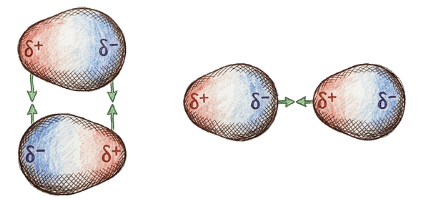
Definition: Dipole-dipole interactions occur between polar molecules, where positive and negative ends of permanent dipoles attract each other.
Key Features:
Present only in polar molecules, where there is a significant difference in electronegativity between atoms in a bond.
Stronger than London dispersion forces but weaker than hydrogen bonds.
Example: Interaction between molecules like hydrogen chloride (HCl) or sulfur dioxide (SO₂), where the dipoles align to maximize attractions between oppositely charged regions.
Factors Affecting Dipole-Dipole Interactions:
Molecular Polarity: The greater the dipole moment (difference in electronegativity between atoms), the stronger the dipole-dipole interaction.
Molecular Orientation: The alignment of dipoles influences the strength of interactions (stronger when aligned end-to-end).
Hydrogen Bonding
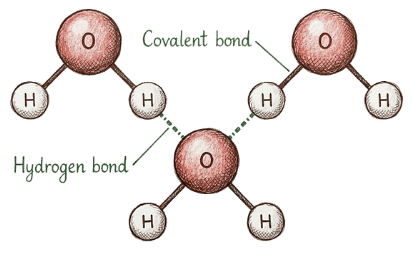
Definition: Hydrogen bonding is a special type of dipole-dipole interaction that occurs when hydrogen is bonded to highly electronegative atoms such as nitrogen (N), oxygen (O), or fluorine (F). The partially positive hydrogen atom is attracted to the lone pair on a nearby electronegative atom.
Key Features:
Strongest type of intermolecular force among the three listed here.
Crucial in determining the structure and properties of water, DNA, and proteins.
Example: Water (H₂O) molecules form hydrogen bonds, which gives water its unique properties such as high boiling point and surface tension. Hydrogen bonds are also present in ammonia (NH₃) and hydrogen fluoride (HF).
Factors Affecting Hydrogen Bonding:
Electronegativity: The more electronegative the atom attached to hydrogen (N, O, or F), the stronger the hydrogen bond.
Molecular Geometry: The presence of lone pairs and the orientation of hydrogen bonds affect their strength.
Topic Related Resources
Lab
Coming Soon...
Lab
Coming Soon...
Demo
Coming Soon...
Demo
Coming Soon...
Activity
Coming soon...
Activity
Coming soon...
Simulation
ChemLEAP Intermolecular Forces
Simulation
Coming soon...
Video Resources


