
Scientific Notation
Core Concept
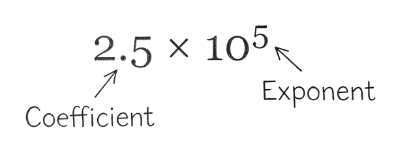
In scientific notation, a number is expressed as the product of a coefficient and a power of 10. The coefficient is a number between 1 and 10, and the power of 10 indicates the scale or magnitude of the number. The power of 10 is determined by the number of places the decimal point needs to be shifted to the left or right to obtain a coefficient between 1 and 10.
Practice Tips
Ensure the coefficient is between 1 and 10, apply exponent rules correctly, and round results according to significant figure rules.
Convert numbers between standard form and scientific notation by moving the decimal point left (for large numbers) or right (for small numbers).
Master multiplication rules: Multiply coefficients and add exponents, e.g., $(2 \times 10^3) \times (3 \times 10^4) = (2 \times 3) \times 10^{3+4} = 6 \times 10^7$
Master division rules: Divide coefficients and subtract exponents, e.g., $(6 \times 10^7) \div (2 \times 10^3) = (6 \div 2) \times 10^{7-3} = 3 \times 10^4$.
Practice addition and subtraction: Align exponents before adding or subtracting coefficients, e.g., rewrite $(3.2 \times 10^4) + (4.5 \times 10^3) = (3.2 + 0.45) \times 10^4 = 3.65 \times 10^4$
Test Yourself
Podcast Episode
Practice Problems & Worked Out Examples 🔒
Core Concept
Scientific notation is a way to express very large or very small numbers in a more compact form.
In scientific notation, a number is expressed as the product of a coefficient and a power of 10. The coefficient is a number between 1 and 10, and the power of 10 indicates the scale or magnitude of the number. The power of 10 is determined by the number of places the decimal point needs to be shifted to the left or right to obtain a coefficient between 1 and 10.
Multiplication and Division
Multiplication
Multiply the coefficients.
Add the exponents of the two numbers.
The resulting number is in scientific notation with the new coefficient and combined exponent.
$\boxed{\text{EXAMPLE PROBLEM}}$ Multiply $2.5 \times 10^3$ by $6.2 \times 10^2$.
$(2.5 \times 6.2) \times (10^3 \times 10^2)$
$15.5 \times 10^{3+2}$ = $15.5 \times 10^5$
Division
Divide the coefficients.
Subtract the exponent of the divisor (number in the denominator) from the exponent of the dividend (number in the numerator).
The resulting number is in scientific notation with the new coefficient and the difference in exponents.
$\boxed{\text{EXAMPLE PROBLEM}}$ Divide 8.4 x 10^4 by 2.1 x 10^2
(8.4 / 2.1) x (10^4 / 10^2) = 4 x 10^2 (We can round 3.99 to 4 here)
Performing Calculations in Scientific Notation
Adding and Subtracting
For addition and subtraction, the numbers must have the same exponent.
Match the Exponents. If the exponents aren't the same, adjust one or both to create matching exponents.
Add or Subtract the Coefficients. Treat the coefficients like regular numbers and perform the addition or subtraction.
Maintain the Exponent. The final answer keeps the same exponent as the original numbers.
$\boxed{\text{EXAMPLE PROBLEM}}$ Add $4.2 \times 10^2$ and $1.35 \times 10^1$.
Change exponents to be the same: convert $1.35 \times 10^1$ to the exponent $10^2$.
The resulting number is: $1.35 \times 10^1 \rightarrow 1.350 \times 10^2$
Now we can add the coefficients (mantissas): $(4.200 + 1.350) \times 10^2 = 5.55 \times 10^2$
Topic Related Resources
Lab
Coming Soon...
Lab
Coming Soon...
Demo
Coming Soon...
Demo
Coming Soon...
Activity
Coming soon...
Activity
Coming soon...
Simulation
Coming soon...
Simulation
Coming soon...
Video Resources

