
Thin Layer Chromatography (TLC) of Analgesics

SAFETY PRECAUTIONS
Eye Protection: Always wear safety goggles to protect your eyes from chemical splashes.
Solvent Handling: The solvents used in this experiment are volatile and flammable. Keep them away from open flames and heat sources. Use them in a well-ventilated area or under a fume hood.
Dichloromethane: Dichloromethane is a hazardous chemical. Avoid skin contact and inhalation. Handle it with care in a well-ventilated area.
UV Light: Do not look directly into the UV lamp. View the TLC plate under the UV lamp through a UV-protective screen or by wearing UV-protective goggles.
Iodine: Iodine is corrosive and toxic. Avoid inhaling iodine vapors. Use the iodine chamber in a fume hood.
Waste Disposal: Dispose of all chemical waste in the designated waste containers as instructed by your teacher.
Background Information
Chromatography is one of the most useful methods of separating and purifying organic compounds. There are many types of chromatography but most depend on the principle of adsorption.
Various types of chromatography includes:
liquid/ column
thin layer (TLC)
Gas chromatography
Paper
The two important components of chromatography are the adsorbent and the eluent.
Adsorbents are usually solid materials that will attract and adsorb the materials to be separated. Adsorbents are also called the stationary phase.
The eluent is the solvent, which carries the materials to be separated through the adsorbent. The eluent is also called the mobile phase.
Chromatography works on the concept that the compounds to be separated are slightly soluble in the eluent and will spend some of the time in the eluent (or the solvent) and some of the time on the adsorbent. When the components of a mixture have varying affinities for the eluent, they can then be separated from one another. The polarity of the molecules to be separated and the polarity of the eluent are very important. Changing the polarity of the eluent will only slightly affect the solubility of the molecules but may change the relative attraction for the adsorbent. Affinity of a substance for the eluent versus the adsorbent allows molecules to be separated by chromatography.
Paper chromatography is often used as a simple separation technique. In paper chromatography, the adsorbent is the paper itself, while the eluent can be any number of solvents. When the paper is placed in a chromatography chamber, the eluent moves up the paper by capillary action. Organic molecules that are "spotted" onto the paper strip separate as they are carried with the eluent at different rates. Those molecules that have a polarity closest to the polarity of the eluent will move up the strip the fastest.
The choice of eluent is the most difficult task in chromatography. Choosing the right polarity is critical because this determines the level of separation that will be achieved. Different samples will spend varying amounts of time interacting with the paper and the solvent. Through these different interactions, the samples will move different distances along the chromatography paper. The distance a sample moves aling the chromatography paper is compared to the overall distance the solvent travels - this ratio is called the Rf value or rate of flow.
The distance a compound travels up the TLC plate can be quantified by its Retention Factor ($R_f$). The $R_f$ value is a ratio calculated as follows:
$$R_f = \frac{\text{Distance traveled by the spot}}{\text{Distance traveled by the solvent front}}$$
Since the $R_f$ value is a ratio, it is a dimensionless quantity. The $R_f$ value of a compound is a physical constant for a given set of TLC conditions (stationary phase, mobile phase, temperature). Therefore, it can be used to identify compounds by comparing their $R_f$ values to those of known standards.
In this lab, you will be analyzing several common analgesics, which may contain one or more of the following active ingredients:
Aspirin
Acetaminophen
Ibuprofen
Caffeine
Salicylamide
By comparing the $R_f$ values of the spots from the analgesic samples to the $R_f$ values of the known standards, you will be able to determine the composition of the analgesics.
Introduction to Analgesics
Analgesics are a class of pharmaceutical compounds designed to alleviate pain without causing a loss of consciousness. In the context of organic chemistry, these compounds are often small, aromatic molecules that differ slightly in their functional groups, which significantly alters their polarity and biological activity. Most common over-the-counter (OTC) analgesics belong to the Non-Steroidal Anti-Inflammatory Drug (NSAID) class, which work by inhibiting cyclooxygenase (COX) enzymes to reduce the production of prostaglandins.
Key Compounds in TLC Analysis
In this lab, you will use Thin-Layer Chromatography (TLC) to identify and compare five common components found in commercial pain relievers. Their chemical structures dictate their "retention factor" ($R_f$) based on how they interact with the stationary phase (usually polar silica gel) and the mobile phase (an organic solvent).
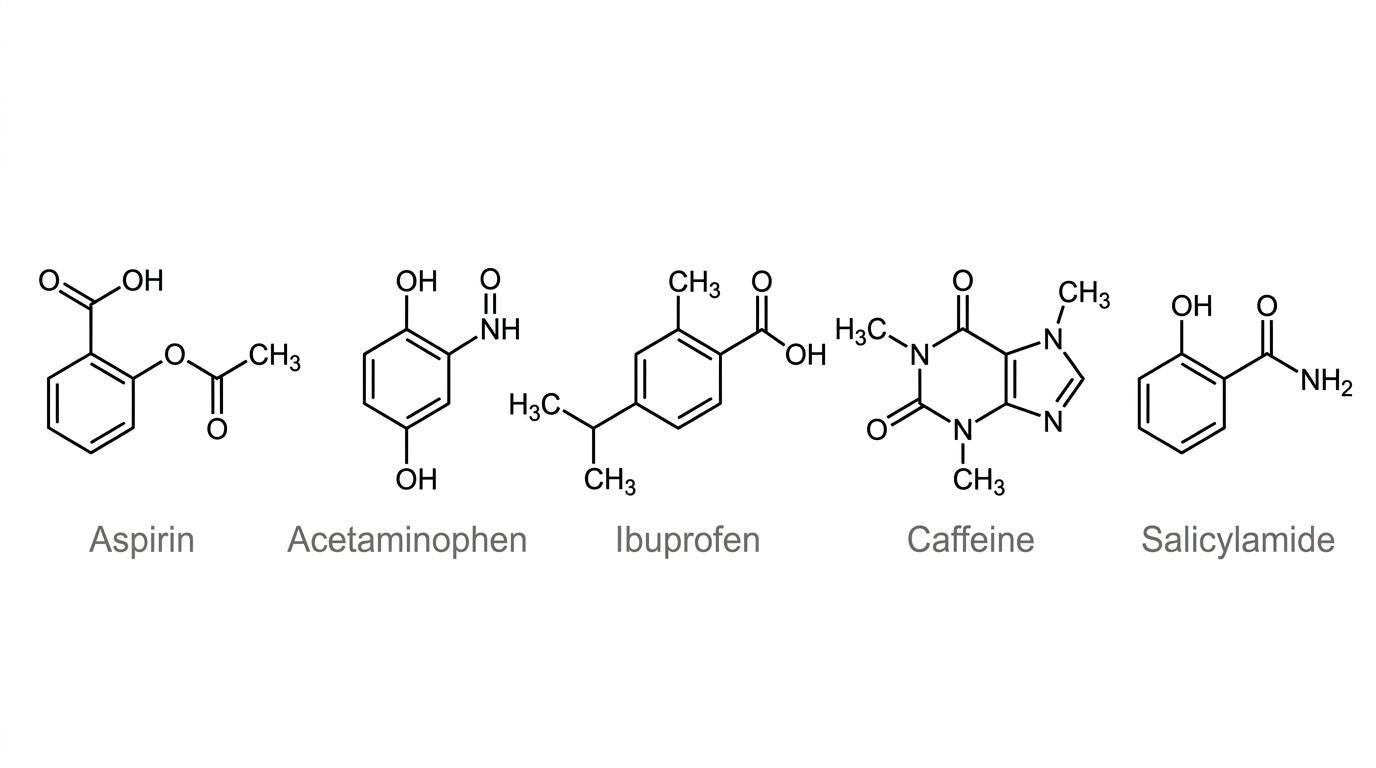
Aspirin (Acetylsalicylic Acid): A derivative of salicylic acid. It contains both an ester and a carboxylic acid group, making it relatively polar and acidic.
Acetaminophen: Unlike NSAIDs, acetaminophen acts primarily on the central nervous system. It features a phenol group and an amide group; its high polarity often results in lower $R_f$ values in non-polar solvents.
Ibuprofen: A propionic acid derivative. It is characterized by a non-polar isobutyl group and a carboxylic acid, balancing its hydrophobic and hydrophilic character.
Caffeine: While not an analgesic itself, caffeine is a xanthine alkaloid often added to pain relievers as an adjuvant to constrict blood vessels and enhance the primary drug's efficacy. It is the most basic and typically one of the most polar compounds in this set.
Salicylamide: A derivative of salicylic acid where the OH group is replaced by an amide. It is used for its analgesic and antipyretic properties, though it is less common in modern formulations than aspirin.
Chromatographic Behavior
The separation of these drugs on a TLC plate is governed by their ability to form hydrogen bonds with the silica gel. Compounds with more "accessible" polar groups (like the hydroxyl and amide groups in acetaminophen) will adhere more strongly to the plate, while less polar molecules (like ibuprofen) will travel further with the solvent front. Understanding these intermolecular forces is essential for predicting the migration patterns of each analgesic.


Calculating Rf factor
This is a video that explains the calculations.

Experimental Set-Up
This is a GREAT video. It explains and shows what we will do in this lab very well. Watch carefully, second by second. It is so good, you should watch it at least twice!

L A B G U I D E