
Calorimetry
Core Concept
Calorimetry is the science of measuring heat transfer. In chemistry, calorimetry is used to determine the heat changes that accompany chemical reactions, phase changes, or specific heat measurements of substances. The device used to measure these heat changes is called a calorimeter.
Key Tips
Check for System Type: Determine if the problem uses a coffee cup (constant pressure) or bomb (constant volume) calorimeter.
Convert Units if Necessary: Ensure mass is in grams, specific heat in J/g°C, and temperature in Celsius.
Watch the Signs: For exothermic reactions, q will be negative (heat released), while for endothermic reactions, q will be positive (heat absorbed).
Account for the Calorimeter Constant: If the calorimeter absorbs heat, include $q_{\text{calorimeter}} = C \cdot \Delta T$ in calculations.
Test Yourself
Podcast Episode
Practice Problems & Worked Out Examples 🔒
Key Concepts in Calorimetry
Law of Conservation of Energy:
In an isolated system, energy is conserved. The heat absorbed by one part of the system equals the heat released by another part.
Heat gained = Heat lost.
Heat (q):
The energy transferred due to temperature difference, typically measured in Joules (J) or calories (cal).
Types of Calorimetry:
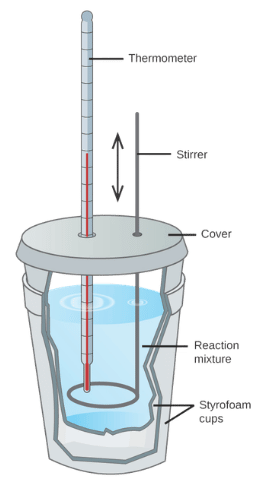
Constant Pressure Calorimetry (e.g., Coffee Cup Calorimeter): Used for reactions occurring in solution where the pressure remains constant.
Constant Volume Calorimetry (e.g., Bomb Calorimeter): Used for combustion reactions in a sealed container where volume remains constant.
Calorimetry Equations
Heat Transfer Formula:
The formula used to calculate the amount of heat (q) absorbed or released by a substance is: q=m⋅c⋅ΔT
Where:
q = Heat absorbed or released (in J or cal)
m = Mass of the substance (in grams)
c = Specific heat capacity (in J/g°C)
ΔT = Temperature change (T_{\text{final}} - T_{\text{initial}}$)
Calorimeter Constant (C):
In some cases, the calorimeter itself absorbs heat. The calorimeter constant (C) is the heat capacity of the calorimeter, accounting for the heat absorbed by the calorimeter materials.
When the calorimeter constant is known: $q_{\text{calorimeter}} = C \cdot \Delta T$
Heat of Reaction (Enthalpy Change, ΔH):
The heat change for a reaction measured under constant pressure conditions. For exothermic reactions, ΔH is negative, and for endothermic reactions, ΔH is positive.
Types of Calorimeters
Coffee Cup Calorimeter:
Simple, open container used for reactions at constant pressure (often atmospheric pressure).
Suitable for reactions in aqueous solution, such as dissolving salts or acid-base neutralization.
Example: Measuring the heat released when dissolving an acid in water.
Bomb Calorimeter:
A more complex, sealed device that operates at constant volume.
Used for combustion reactions, such as burning fuels or food samples.
The reaction takes place in a metal container (bomb) submerged in water to absorb the heat released.
Topic Related Resources
Lab
Coming Soon...
Lab
Coming Soon...
Demo
Coming Soon...
Demo
Coming Soon...
Activity
Coming soon...
Activity
Coming soon...
Simulation
Coming soon...
Simulation
Coming soon...